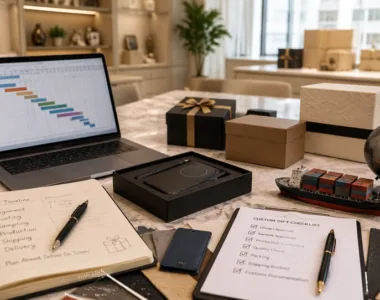
Gift Sample Approval is the moment where most buyers smile, sign off, and unknowingly set up their own disaster. I’ve seen it a hundred times. The sample arrives. It’s beautiful. Perfect logo placement. Gorgeous color. Feels premium. The buyer takes a photo, emails the team: “Approved!” Three months later, the container arrives. The logo is drifting 3mm left. The color is orange instead of red. The “premium feel” came from a hand-polished prototype that can’t be replicated at scale. That beautiful sample? It was a Gift Sample Approval trap. Gift Sample Approval isn’t about asking “Does this look nice?” It’s about asking “Can 5,000 units look exactly like this, on a Tuesday, in a factory that’s running three shifts?” That’s a completely different question. And most buyers never ask it.
Why Gift Sample Approval Is Where Orders Live or Die
Here’s a truth that took me years to learn: the biggest risk in the Gift Sample Approval process isn’t a bad sample. It’s a misleadingly good sample. A bad sample is easy to catch in Gift Sample Approval. You see the flaw, you reject it, you fix it. A misleadingly good sample is dangerous. It passes every visual check, then fails catastrophically in production. Because it was made by the factory’s best worker, using special materials, with unlimited time. Not by the Tuesday shift, with standard materials, under deadline pressure. Gift sample approval is your last real chance to catch what production will miss. After Gift Sample Approval, when you sign that approval sheet, the factory locks the specs. Whatever you approved—good or bad—is what 5,000 units will look like. No pressure.
Check 1: Color — Pantone Matching (Not “Close Enough”)
The most common Gift Sample Approval quality check failure? Color. And it’s not because factories can’t match colors. It’s because buyers don’t specify how to check them. The trap: You hold the sample under your office LED lights. It looks “close enough.” You approve. The factory produces under fluorescent factory lights. Your recipient opens it under natural window light. Three different colors. Three different opinions on whether it’s “right.” What to actually do in Gift Sample Approval:
- Specify Pantone solid coated number. Not “red.” Not “our brand red.” Pantone 185 C.
- Check under multiple light sources: daylight, LED, fluorescent.
- If the material is fabric or textured, request a lab dip or strike-off, not just a printed swatch.
- For multi-color logos, check registration—do the colors align at the edges, or is there a halo? Real story: A client’s Gift Sample Approval on a sample notebook with “navy blue” cover. No Pantone specified. The pre-production sample approval looked fine under their office lights. The production batch arrived purple under daylight. Why? The factory used a dye that shifted under UV. Cost to re-dye 3,000 covers: $4,200. Cost to specify Pantone 289 C upfront: $0.
Check 2: Logo Positioning — Millimeters Matter
“The logo looks centered.” Famous last words. In Gift Sample Approval, “centered” is not a measurement. It’s an opinion. And opinions don’t scale. What to actually check in Gift Sample Approval:
- Measure from fixed reference points. Not “centered on the front.” “Logo center 45mm from left edge, 30mm from top edge.”
- Check on multiple samples. If sample 1 is 45mm and sample 2 is 48mm, that’s a 3mm tolerance. Acceptable for some products. Disastrous for others.
- For curved surfaces (bottles, mugs), check distortion. A flat logo on a curved sample might look stretched in production.
- For embroidery, check stitch density. A loose sample becomes a threadbare production unit. Real story: A tech company’s Gift Sample Approval passed on 2,000 branded water bottles—the logo “looked centered.” Production arrived. Logo drifted 4mm right on 60% of units. Why? The factory used a manual jig for the sample, then switched to a faster semi-automatic jig for production. The sample was perfect. The production jig had 3mm play. No one measured. Everyone assumed.
Check 3: Material — What the Sample Is Made Of (Not What It Feels Like)
“Feels premium” is not a material specification. It’s a mood. In Gift Sample Approval, the material check is where most buyers get fooled. The factory sends a sample with upgraded materials—thicker, softer, heavier—because they want the order. Then production uses standard materials to hit the price point. What to actually check:
- Ask for material specifications in writing: GSM for paper, denier for fabric, grade for metal.
- Weigh the sample. A 300gsm notebook sample that becomes 250gsm in production is a 17% downgrade you can feel.
- Check material consistency across the sample. Is the cover the same thickness on the front and back? Are the pages uniformly white, or do they shift from warm to cool white?
- For recycled or sustainable materials, request certification. A “recycled” sample that isn’t certified in production is a lawsuit waiting to happen. Real story: A client ordered “premium cotton tote bags.” Sample felt thick, sturdy. Production arrived thin, floppy. The sample was 12oz cotton. Production was 8oz. The factory “optimized” the material to hit the price target after the sample was approved. The client never specified GSM in the gift sample inspection checklist. They assumed “premium” meant something.
Check 4: Function — Does It Actually Work?
The most embarrassing Gift Sample Approval quality check failure? The product doesn’t function. I’ve seen branded pens that don’t write. USB drives that don’t connect. Wireless chargers that only work if the phone is positioned at exactly 23 degrees. All approved because “the logo looked great.” What to actually check:
- Test every function. Not once. Five times. With different users.
- For electronics, test with the intended device. An iPhone charger that works on Samsung is useless for your Apple-centric audience.
- For apparel, test fit on multiple body types. A “one size fits most” that fits none of your recipients is a donation pile, not a gift.
- For food items, check shelf life and storage requirements. A chocolate sample that arrives perfect in winter might be soup in summer shipping. Real story: A financial services client ordered branded power banks. Their Gift Sample Approval focused only on logo and color. No one tested the power bank. Production arrived. 30% wouldn’t hold charge past two hours. The factory used a cheaper battery cell after sample approval. The client’s event was in three days. They bought 600 replacement units from a local retailer at 3x cost. The “savings” from not testing function cost $8,400.
Check 5: Construction — Will It Survive Shipping (And Use)?
A sample that sits on a desk is not a sample. It’s a sculpture. Real products get thrown in bags, dropped, stacked, shipped. In Gift Sample Approval, construction checks are where you separate “looks good” from “lasts long.” What to actually check:
- Stress test seams, zippers, handles. Pull. Tug. Load with weight.
- Drop the sample from desk height. Does it dent? Crack? Shatter?
- Check adhesive points. A glued label that peels in week one is a brand impression that lasts… one week.
- For packaging, check closure mechanisms. A magnetic box that opens in shipping is a product that arrives looking used. Real story: A client ordered branded ceramic mugs with gift boxes. Sample was gorgeous. Construction approval: passed. No one tested the box closure under vibration. 2,000 mugs shipped ocean freight. Arrived with 40% of boxes opened, mugs chipped from rubbing together. The “gift” looked like garage sale leftovers. Replacement cost: $6,000. Reputation cost: unmeasurable.
Check 6: Packaging — The Unboxing Is Part of the Product
Packaging isn’t wrapping. It’s the first impression. And in Gift Sample Approval, packaging is usually an afterthought. What to actually check:
- Is the packaging in the sample the same as production packaging? A sample with a hand-folded prototype box might not be replicable at volume.
- Check print quality on packaging. A blurry barcode or smudged logo on the box undermines the product inside.
- For retail-style packaging, check hang holes, tear strips, and shelf stability. A product that can’t be displayed is a product that can’t be seen.
- For international shipping, check if packaging is durable enough for the journey. A beautiful retail box that arrives crushed is a waste of money. Real story: A cosmetics client ordered branded gift sets. Sample packaging was a rigid box with ribbon. Beautiful. Production packaging was the same design but using thinner board to save cost. The ribbon pulled through the lid on 15% of units. The “luxury unboxing” became a frustrating wrestling match. The client had to repackage 300 units by hand. Labor cost: $2,100. Lesson: specify board weight in the gift sample inspection checklist.
Check 7: The “Tuesday Shift” Test — Can This Be Replicated?
This Gift Sample Approval check separates professionals from amateurs. And it’s the one almost no one does. The “Tuesday shift” test asks: “Can the factory’s average worker, on an average day, make 5,000 units that look exactly like this sample?” What to actually check:
- Ask how the sample was made. Hand-finished? Special machine? Prototype process that won’t exist in production?
- Check for manual touches that don’t scale. A hand-tied ribbon on a sample becomes a machine-tied bow in production. Different look, different feel.
- For complex assemblies, ask for a production simulation. Can they make 10 units that match the sample, using production methods, in production time?
- For color-critical items, ask about batch-to-batch variation. That perfect Pantone match on the sample—what’s the acceptable delta E for production? (Hint: If they don’t know what delta E is, you’re in trouble.) Real story: A client ordered branded leather portfolios. Sample was hand-stitched by the factory’s master craftsman. Beautiful. Passed gift sample approval with flying colors. Production arrived. Machine-stitched. Functional. But the hand-stitch detail that made the sample special was gone. The client felt betrayed. The factory said, “You didn’t specify hand-stitch.” They were technically correct. And the client had 2,000 portfolios that didn’t match their vision. That’s the approval sample vs production gap. And it’s where dreams die.
The Giftdonna Gift Sample Approval Process
Let me share how we handle this. Giftdonna’s Gift Sample Approval process doesn’t send samples for “approval.” We send them for validation. There’s a difference. Approval means “Looks good, ship it.” Validation means “We’ve checked these 7 points against production reality, and here’s what you need to know.” Real example: A client received a sample wireless charger. Beautiful. Logo perfect. Color matched. They were ready to approve. We stopped them. “The sample was made with a manual positioning jig. Production will use semi-automatic. Here’s a second sample made with the production jig. Notice the logo is 1mm lower. Still within spec, but different. Also, the sample battery is A-grade. Production will use B-grade to hit price. Here’s a test of the B-grade battery. Hold time is 20% shorter. Still functional, but different. Your call.” That conversation took 15 minutes. It saved a $12,000 order from disappointment. That’s what golden sample quality control actually means. Not a perfect sample. A honest sample. One that shows you production reality, not production fantasy.

Sample Approval Timeline: When to Start Checking
Here’s the Gift Sample Approval timeline most buyers don’t know:
表格
复制
| Stage | What Happens | Your Job | Typical Time |
|---|---|---|---|
| Concept sample | Rough mockup, materials not final | Check size, shape, general direction | 3-5 days |
| Pre-production sample | First real sample, production methods | Full 7-check validation | 5-7 days |
| Golden sample | Approved master for production comparison | Sign off, store securely | 2-3 days |
| Production check | First 5-10 units off the line | Compare to golden sample | 1-2 days |
| Pre-shipment sample | Random unit from finished batch | Final verification before ocean | 2-3 days |
| Most buyers do one sample check. Professionals do five. Each catches different problems at different stages. The earlier you catch it, the cheaper it is to fix. |
Final Word
Gift Sample Approval is not a beauty contest. It’s a stress test. The sample that looks perfect under desk lights might be a production nightmare. The sample with minor imperfections might be the most honest representation of what you’ll actually receive. The 7 checks—color, positioning, material, function, construction, packaging, and replicability—are your defense against the single most expensive mistake in custom gifting: approving the wrong thing. If you’re about to sign off on a sample, or if you’ve been burned before and want a second set of eyes on your next one—send it over. Giftdonna doesn’t just manage Gift Sample Approval. We validate reality. Get Your Sample Validation Checklist →
Giftdonna — Corporate Gifting Export Services. Making sure what you approve is what you get, since 2010.
You Might Also Like to Read These: