Let me be straight with you — most “guides” about ordering custom corporate gifts are useless. They don’t actually walk you through the Custom Gift Order Journey — the real one, with the messy middle parts. They tell you to “define your budget” and “choose a supplier,” as if you haven’t already figured that out by hour two of your first Google search.
What nobody tells you is what actually happens once you hit “send” on that purchase order. The real custom gift order journey — the one where things go slightly wrong, then get fixed, then go more wrong, then somehow work out — that’s the story buyers need.
I’ve watched this play out hundreds of times at Giftdonna. Not from a spreadsheet. From factory floors, WhatsApp threads with suppliers at 11 PM, and that specific stomach-drop moment when a sample arrives and the logo is… not quite right.
So here’s the unfiltered version. The custom gift order journey that international buyers actually walk through, stage by stage, with the stuff that keeps procurement managers up at night.
What “Custom Gift Order Journey” Actually Means (And Why It Matters)
When people search for a custom gift order journey, they’re usually in one of two spots: either they’re about to place their first bulk order and they’re terrified, or they just got burned by a previous supplier and they’re trying to figure out where exactly things went sideways.
The journey isn’t just “order to delivery.” It’s a sequence of decision points where small mistakes compound. Miss something on Day 12? You’ll find out on Day 45, when your container lands and 30% of the boxes are crushed because nobody checked the corrugate rating.
At Giftdonna, we map this out into five distinct phases. Not because it looks nice in a deck — because each phase has its own failure mode, and each needs its own checklist.
Phase 1: The Quiet Before the Storm (Days 1–5)
The Custom Gift Order Journey always starts with optimism. You’ve got your supplier shortlist, maybe you’ve requested quotes from three vendors in Shenzhen or Ningbo, and you’re comparing unit prices like they tell the whole story. You’ve got your supplier shortlist, maybe you’ve requested quotes from three vendors in Shenzhen or Ningbo, and you’re comparing unit prices like they tell the whole story.
Here’s what actually matters in this phase but rarely gets discussed:
The quote comparison trap. A supplier quoting $4.20/unit versus one at $3.80 isn’t necessarily more expensive. The $4.20 quote might include the Pantone-matched gift box. The $3.80 quote might be planning to slap your logo on whatever white box they have in the warehouse and call it “custom packaging.” I’ve seen buyers save $0.40 per unit and spend $2,000 extra on repackaging at a third-party warehouse because they didn’t catch this.
The MOQ conversation. Minimum order quantities aren’t always fixed. A factory might list 1,000 units, but if you’re ordering 800 of one SKU and 200 of another, and both use the same base material, there’s often room to negotiate. But you have to ask the right way — “Can we combine material runs?” not “Can you lower your MOQ?”
The sample conversation. This is where you set the tone for everything that follows. A rushed sample request — “Just send me whatever you have” — signals to the factory that you’re not detail-oriented. A detailed sample brief, with logo files in vector format, specified Pantone codes, and photos of where exactly the branding should sit? That signals you’re going to be a pain to work with, in the best possible way. Factories respect buyers who know what they want.
At Giftdonna, we typically spend 3–5 business days in this phase just getting the sample specifications locked. It feels slow. It’s not. It’s the phase that prevents the disasters that happen in Phase 3.
Phase 2: Gift Sample Approval Day — The Moment of Truth
This phase — Sample Approval Day — is the pivot point of the entire Custom Gift Order Journey. This is its own standalone article (and will be), but let me give you the executive summary because it’s the pivot point of the entire custom gift order journey.
Sample approval day isn’t about whether the product “looks nice.” It’s about whether the product can be replicated at scale, 1,000 or 10,000 times, with the same result.
The specific checks that matter:
- Logo placement consistency across three sample units (not one — three)
- Color shift under natural daylight versus fluorescent warehouse lighting
- Functional testing: does the ceramic mug handle feel the same after 50 grips? Does the power bank charge an iPhone 15 without the “unsupported accessory” warning?
- Packaging integrity: if this box gets dropped from waist height, what happens?
We once had a client — a fintech company in Singapore — approve a beautiful PU notebook sample. Glossy debossed logo, perfect. But we insisted on a second sample with the actual production tooling, not the prototype tool. The deboss depth came out 0.3mm shallower. Barely visible to a casual eye. But at 5,000 units, that shallow deboss made the logo look cheap under direct light. We caught it. Production tooling got adjusted. Crisis averted. That’s the kind of moment that defines whether your Custom Gift Order Journey ends in relief or regret.
That’s the kind of moment that defines whether your custom gift order journey ends in relief or regret.
Phase 3: Production — Where Time Either Flies or Dies
Once samples are locked, the Custom Gift Order Journey enters production scheduling. This is where international gift procurement gets its reputation for “unpredictable timelines.”
The reality is more nuanced. Production delays usually aren’t about the factory being slow. They’re about upstream material availability, especially for custom colors or specialized components.
The buyers who handle this well are the ones who build 10–15% buffer into their timeline and ask early: “What’s your longest-lead material on this order?” Not “When will it be done?” This question alone can save your Custom Gift Order Journey from a six-week surprise.
Real scenario from last quarter: A UK client ordered 2,000 custom-branded stainless steel tumblers in a specific matte navy. The factory had the steel shells in stock, but the powder coating supplier was running two weeks behind because of a local environmental inspection. Not the tumbler factory’s fault. Not something any standard timeline would predict. But it pushed delivery from week 6 to week 8.
The buyers who handle this well are the ones who build 10–15% buffer into their timeline and ask early: “What’s your longest-lead material on this order?” Not “When will it be done?”
During production, we typically do mid-production checks — not full inspections, but spot checks at 20% completion. Are the logos drifting from center? Is the color batch consistent? Catching drift at 400 units is infinitely cheaper than at 2,000.
Phase 4: Packaging Inspection Before Shipping — The Last Line of Defense
Packaging inspection is where the Custom Gift Order Journey transitions from making to moving. This phase gets overlooked because it’s not “sexy.” Nobody posts on LinkedIn about box compression tests. But packaging failures are responsible for more customer complaints than production defects, in our experience.
The specifics that matter for international shipments:
Outer carton specs. For ocean freight, you want 5-ply corrugated, minimum. Not 3-ply. The difference in compression strength is roughly 40%, and that matters when containers are stacked six high in a port yard.
Inner protection matching. A glass award and a polyester polo shirt should not use the same filler. We specify PE foam inserts for rigid items, tissue + bubble hybrid for textiles, and custom die-cut cardboard for anything with a precise shape. Generic “foam” is not a specification.
Label accuracy. This sounds obvious until you’ve had a shipment held at customs because the carton label said “promotional materials” but the commercial invoice said “corporate gifts.” Different HS codes. Different duty treatments. Different delay.
We photograph every packaging inspection. Not for marketing — for documentation. If a client receives damaged goods, we need to prove the cartons left our facility intact. It’s boring. It’s necessary.
Phase 5: Container Loading and the Final Handoff
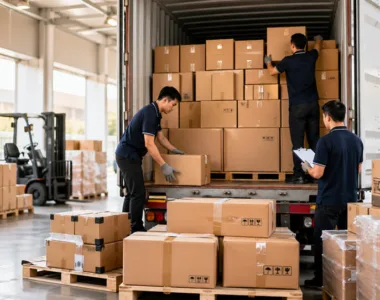
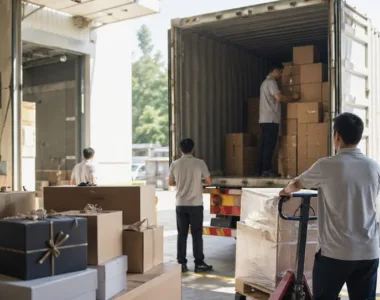
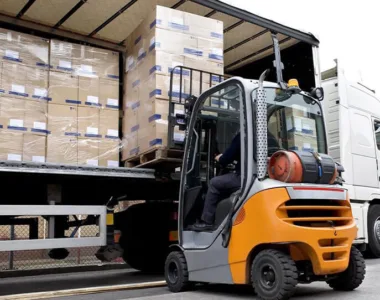
Container loading is the final physical act of the Custom Gift Order Journey before your gifts become someone else’s problem. Container loading for custom gifts is its own skill. It’s not “put boxes in a metal box.” It’s spatial optimization with risk management layered on top.
Heavy cartons (glass, ceramic, metal) go floor-level. Lightweight items (apparel, paper goods) stack above. But it’s more subtle than that. You want weight distributed evenly across the container floor to avoid axle load issues during trucking. You want aisles for loading/unloading efficiency. You want desiccant packs if the route passes through humidity zones — which, if you’re shipping from Ningbo to Rotterdam via the Suez, it definitely does.
We had a shipment of leather-bound journals last year where the container condensation — not direct water damage, just humidity buildup over a 28-day sea journey — caused the covers to warp slightly. Not ruined. But not perfect. Now every paper-goods shipment gets silica gel packs and vapor barrier lining. Lesson learned. Added cost: $0.08 per unit. Avoided complaint rate: worth it.
The final handoff isn’t just the Bill of Lading. It’s the communication cascade: factory confirms loading, freight forwarder confirms sailing, we confirm ETA to client, client confirms warehouse receiving capacity. One broken link in that chain — a warehouse closed for a holiday you didn’t know about — and your “on time” shipment sits in a port storage facility accumulating demurrage fees.
The Timeline Nobody Shows You
Here’s what the **custom gift order journey** actually looks like, with realistic ranges:
| Phase | Typical Duration | Where It Goes Wrong |
|---|---|---|
| Sourcing & quoting | 3–7 days | Comparing apples to oranges on specs |
| Sample development & approval | 7–14 days | Approving the “pretty” sample instead of the “production-representative” sample |
| Production | 15–30 days | Material delays, tooling issues, color drift |
| Packaging & inspection | 3–5 days | Wrong carton specs, label errors |
| Shipping (ocean) | 20–35 days | Port congestion, customs holds |
| Total realistic timeline | 48–91 days | Buffer: add 10–15% |
That’s the realistic Custom Gift Order Journey timeline. Not the one on the supplier’s website. That 48-day best case? It happens. But only when every phase is managed actively, not passively.
What Buyers Actually Worry About (And What We Do About It)
The buyers who handle the Custom Gift Order Journey well build buffer and ask early. I’ve sat in enough client calls to know the recurring anxieties:
“Will the quality match the sample?” — Mid-production checks and final random inspection (AQL 2.5 standard, if you want the technical term).
“Will it arrive in time for our event?” — We build timeline models with three scenarios: optimistic, realistic, pessimistic. Clients pick their risk tolerance.
“Will I know what’s happening?” — Weekly status updates, with photos, not just “on track” emails. If there’s a problem, we say so immediately. Surprises are for birthdays, not supply chains.
“What if something goes wrong after delivery?” — We track defect rates by product category and supplier. If a pattern emerges, we address it at the source, not with Band-Aid replacements.
Why This Matters for Your Brand
By now you get it — the Custom Gift Order Journey isn’t about boxes and boats. It’s about controlling the experience that ends up in someone’s hands, on their desk, in their kitchen. It’s a brand touchpoint. The gift you send is the only physical object from your company that some recipients will ever hold.
A cheap-feeling gift doesn’t just waste budget. It sends a signal about how much you value the relationship. A delayed gift doesn’t just miss an event. It communicates disorganization. A damaged gift doesn’t just need replacement. It creates a micro-frustration that associates with your brand.
The custom gift order journey isn’t about boxes and boats. It’s about controlling the experience that ends up in someone’s hands, on their desk, in their kitchen.
FAQ: The Questions We Get Asked Most
How early should I start planning a bulk gift order?
Starting your Custom Gift Order Journey 90–120 days out is ideal. (we’ve turned around full production in 21 days), but they cost more and carry higher risk.
Can I split shipments to multiple destinations?
Yes, but specify this at quoting. It affects packaging (individual vs. bulk cartons), labeling, and freight structure.
What’s the most common mistake first-time buyers make?
Approving the first sample because it “looks fine.” The first sample is a prototype. The second sample, made with production tooling, is what you’re actually buying.
How do I know if a supplier is reliable?
Ask for their defect rate, not their promises. Ask for photos of their last three shipments, not their showroom. Ask how they handle problems, not whether they have them. “What if my timeline doesn’t allow for proper sample approval?” Then your timeline is wrong. Seriously. Rushing sample approval to hit a date is like skipping the foundation to finish a house faster. The date you hit will be the date you regret. Every shortcut in your Custom Gift Order Journey shows up eventually — usually when it’s too late to fix.
Wrapping This Up
The custom gift order journey isn’t complicated, but it is detailed. And the details are where the value lives — or where it leaks out.
If you’re managing international gift procurement, you don’t need another generic checklist. You need someone who’s been through the specific journey you’re about to take, who knows where the potholes are, and who’ll tell you the truth when things aren’t going to plan.
That’s what we try to be at Giftdonna. Not perfect — nobody is — but experienced, transparent, and genuinely invested in the stuff we ship bearing your logo actually working out.
If you’ve got a gift project coming up and you want to talk through the timeline, the risks, or just whether your specs are realistic. No pitch deck. Just a conversation about what you’re trying to do, and whether we’re the right people to help you do it.
If you’re managing your first Custom Gift Order Journey and want to talk through the risks, [reach out].
Because getting your Custom Gift Order Journey right from the start is cheaper than fixing it halfway through.
Related reads from this series:
- Gift Sample Approval Day: The 19 Checks That Save Your Entire Order
- Packaging Inspection Before Shipping: Why Your Cartons Matter More Than Your Product
- Container Loading for Custom Gifts: Space, Weight, and What Can Go Wrong
- What Happens After Production Ends: The Final Mile Most Buyers Ignore