
Gift Budget Per Person strategy: The same budget can buy landfill or loyalty. The difference isn’t the money—it’s the strategy.
Gift budget per person. Sounds simple, right? But every year around Q3, my inbox fills with the same question: “We’ve got $15 per head. Can we actually get something decent?”
Here’s the thing. Gift budget per person isn’t a math problem—it’s a choice problem. The same $15 can buy you landfill-bound plastic or something that sits on a client’s desk for two years. I’ve been in the promotional products and corporate gifting export business long enough to know the difference isn’t the money. It’s what you do with it.
So let’s cut through the noise. Three real tiers for Gift Budget Per Person: $1, $10, $50. What they actually get you, where they fall flat, and how smart buyers stretch them.
Why Gift Budget Per Person Matters More Than Your Total Spend
I’ve watched too many procurement managers obsess over the $50,000 line item while completely ignoring per head gift allocation. They divide by headcount, get $25, and call it a day.
Then half the recipients toss the item in a drawer. Or worse, the trash.
The total budget is a fantasy. The per-person number is where the game is won or lost. A buyer who understands gift budget by recipient tier can make $10 feel like $30. The secret isn’t cutting corners—it’s cutting the right corners for the right people.
Here’s the framework most buyers never use:
表格
| Tier | Gift Budget Per Person | Purpose |
|---|---|---|
| Tier 1 (Mass) | $1–$5 | Brand exposure. Don’t expect gratitude. |
| Tier 2 (Core) | $8–$15 | Employee gift budget range territory. Practical + memorable. |
| Tier 3 (VIP) | $30–$50 | Relationship capital. This is where loyalty is bought. |
Same total budget. Completely different outcomes.
What $1 Gift Budget Per Person Actually Buys (Spoiler: Not Much, But Strategically Useful)
Let’s be honest. $1 won’t buy you loyalty. It won’t buy you love. In most cities, it won’t even buy you coffee.
But in the promotional products world, $1 is a battlefield—and it can be won.
I had a tech client, roughly 800 employees, annual kickoff event. Their gift budget per person for the all-hands giveaway? $1.20. They went with a custom phone stand—lightweight, branded, surprisingly functional. Two years later, I still see those stands on desks in their LinkedIn photos. Cost per impression? Fractions of a penny.
Compare that to the $0.80 pen I saw another company order. Same budget ballpark. The pens arrived, half didn’t write out of the box, and the rest died after three pages. Straight to landfill. Same $1, opposite result.
The difference? Usage-scenario binding. The phone stand solved a daily problem. The pen created a daily frustration.
At $1 Gift Budget Per Person, your job isn’t to impress. It’s to not annoy while keeping your brand visible. Choose items that live where eyeballs already are—desks, fridges, car dashboards. Avoid anything that requires quality to function (pens, lighters, anything with moving parts).
The $10 Sweet Spot — Where Most Employee Gift Budget Range Lives
$10 is the DMZ of corporate gifting. Below $10, recipients sense cheapness. Above $10, finance starts asking questions. $10 is the ceasefire between what employees expect and what CFOs approve.
But here’s the trap: average thinking.
I worked with a retail chain, 800 stores nationwide, holiday gift budget per employee locked at $10. Their first idea? Branded tumblers. Practical, right? Except Arizona stores needed cold retention, Minnesota stores needed heat. One product, two climates, half the country disappointed.
Per head gift allocation isn’t about equality. It’s about perceived personalization at scale.
We swapped the tumbler for a $9.50 notebook-and-pen set. No temperature issues. No sizing. The notebook had a subtle brand mark on the back cover—not the cover, the back—so it felt like a real notebook that happened to be from their company, not a billboard they were forced to carry. Usage rate? North of 90%.
Meanwhile, I’ve seen $12 custom T-shirts turn into a logistics nightmare. Thirty percent return rate for size swaps. The “gift” became a chore for HR.
At $10, the enemy isn’t price. It’s complexity. The simpler the item, the higher the win rate.
A note on sourcing: This is where international procurement gets interesting. A reliable intermediary can aggregate five clients’ $10 orders into one factory’s $40,000 production run. You get MOQ pricing without MOQ volume. Try going factory-direct with a $10-per-head order and a 200-person headcount. The factory won’t even return your email.
$50 — The VIP Gift Budget Amount That Separates Pros from Amateurs
$50 is where things get serious. It’s also where things go spectacularly wrong.
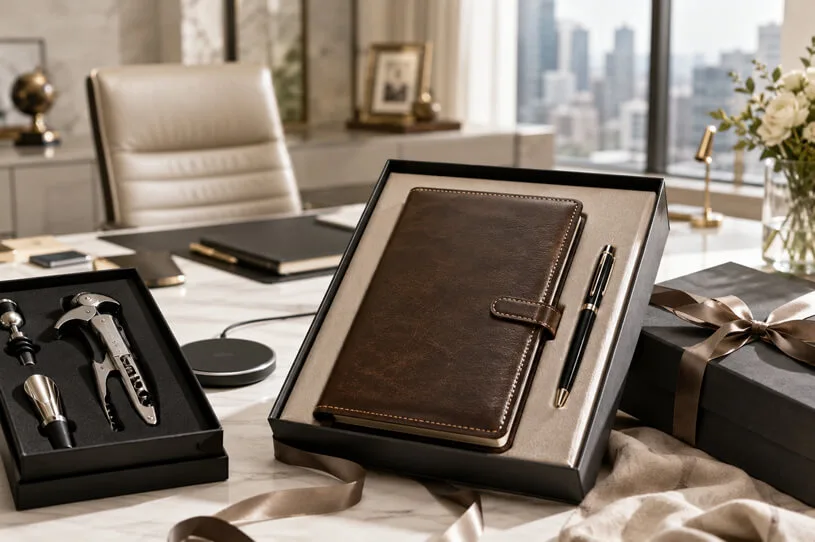
I once saw a consulting firm drop $48 per unit on what they called a “premium wine opener set” for their top 50 clients. Beautiful packaging. Heavy weight. Looked expensive. One problem: three of those clients didn’t drink alcohol. The gift never got opened. One client gave it to their assistant. Another re-gifted it at a white elephant party. The firm’s $2,400 bought them… nothing.
Year two, same firm, same budget. But this time, they did homework. $45 custom leather notebook. On the inside cover, gold-embossed with the client’s company founding year. Not the consulting firm’s logo—the client’s own milestone. The recipient posted it on LinkedIn. Tagged the firm. Organic reach to 4,000+ people in their industry.
Same $50-ish budget. Opposite outcomes.
The lesson? At VIP gift budget amount levels, uniqueness beats luxury. A $50 item that feels mass-produced is an insult. A $45 item that feels one-of-one is an investment.
I’ve also seen $50 wireless charging pads bomb. Perfectly functional. High perceived value. But the recipient already had three. It went into the “tech drawer of forgotten gadgets.” No memory, no association, no ROI.
At this tier, customization isn’t a nice-to-have. It’s the whole point. And customization takes time—4 to 6 weeks from design lock to delivery. The leather notebook I mentioned? Three rounds of sampling to get the embossing depth exactly right. The difference between “cheap gold sticker” and “this feels heirloom.” That’s what an experienced intermediary manages. Not price negotiation. Quality negotiation.
How Much to Spend on Business Gifts? A Decision Tree
Still not sure where you land? Here’s the cheat sheet I share with buyers who want a straight answer.
表格
| Recipient | Budget | Goal | Winning Strategy |
|---|---|---|---|
| Mass audience / trade show | $1–$3 | Brand visibility | Lightweight, logo-forward, zero failure points |
| Employees / general clients | $8–$12 | Appreciation + utility | Practical, no sizing, subtle branding |
| Key accounts / anniversaries | $15–$25 | Relationship maintenance | Story-driven, display-worthy, handwritten note |
| VIPs / C-suite / decision makers | $35–$50 | Loyalty + advocacy | Unique, culturally aware, invisible or minimal logo |
Notice what’s missing? There’s no “everyone gets the same thing.” Gift budget by recipient tier isn’t unfair—it’s strategic. Your intern and your top client’s CEO do not need the same water bottle.
Holiday Gift Budget Per Person — The Q4 Panic Guide
Every October, my WeChat starts buzzing.
“Christmas gifts. 2,000 people. $12 per head. Need delivery by December 15.”
“Great,” I say. “When do you want to place the order?”
“…Next week?”
Here’s the math they never do. Ocean freight: 30 days. Customs clearance: 7 days. Domestic distribution: 5 days. That’s 42 days minimum. Add 2 weeks for production and sampling. We’re at 56 days. From October 15, that lands you December 10—if nothing goes wrong.
Spoiler: something always goes wrong.
“What about air freight?” they ask.
Air freight adds roughly $4 per unit. Your holiday gift budget per employee just went from $12 to $16. That’s a 33% overrun. For 2,000 units, that’s $8,000 you didn’t budget.
Or—and this is the conversation I actually enjoy—you planned ahead. You locked your gift budget per person in July. You approved samples in August. Production ran September. Ocean freight sailed October 1. Your goods arrive November 15 with two weeks to spare. You spend $0 on air freight. You spend $0 on panic. You spend $0 explaining to the CFO why the per-head number moved.
Q4 gifting isn’t a budget problem. It’s a calendar problem. Gift budget per person in Q4 needs a 1.3x reality multiplier to account for rush costs.
Gift Budget Per Person ROI Justification — How to Defend Your Number to the CFO
CFOs don’t care if employees “liked” the gift. They care if the gift moved a number.
I don’t fight that. I use it.
Manufacturing client. Annual gift program was $8 per employee. We pushed it to $15. Employee NPS score moved 12 points. Not because the gift was revolutionary—a slightly nicer backpack, better zippers, actual padding—but because the signal was: “This company is willing to spend $7 more on me.”
Another client, B2B services. VIP client gift budget amount was $50, generic gift box. We switched to $45, custom-researched, culturally specific items. Client renewal rate went from 73% to 89%. The gift didn’t close the deal. The gift kept the conversation warm for 12 months.
Gift budget ROI justification isn’t about proving what you spent. It’s about modeling what happens if you under-spend. The cost of a lost client. The cost of a disengaged employee. The cost of being forgettable.
The Giftdonna Perspective — What 1,000+ Orders Taught Us
Let me share something that took me years to articulate.
Giftdonna has handled everything from $0.80 promotional magnets to $50 custom gift sets. Thousands of orders. Dozens of countries. And I’ve noticed a pattern that contradicts intuition: Lower-budget clients are usually more demanding. Higher-budget clients are usually more trusting.
Why? Because the buyer who truly understands gift budget per person has already done the hard thinking. They know what effect they want. They know what tier they’re buying for. They come to us with clarity.
The buyer who doesn’t understand per head gift allocation? They bring $10 and expect $50 magic. They bring $50 and expect $500 surprise. They’re not buying a gift. They’re buying a feeling—and they can’t describe it.
Our job isn’t magic. It’s translation. We take your desired outcome and translate it into factory instructions.
“I want employees to feel valued.”
Translation: Not expensive. Personal. We landed on $12 custom-name notebooks. Under budget. Over-delivered on sentiment.
“I want clients to remember us.”
Translation: Not loud. Persistent. We chose an $8 desktop phone stand. Client uses it daily. Logo in peripheral vision for two years.
Gift budget per person isn’t a ceiling. It’s a starting line. How you run the race depends on how well you know the track.
Final Word
Gift budget per person isn’t about finding the cheapest option that doesn’t embarrass you. It’s about matching dollars to outcomes with surgical precision.
$1 buys visibility. $10 buys goodwill. $50 buys relationships. But only if you know what you’re actually purchasing.
If you’re staring at next year’s numbers and wondering what your gift budget per person can realistically achieve—or if you’ve got a budget but no idea where it goes—let’s talk. Giftdonna doesn’t do magic tricks. We do translation: your budget, your goals, turned into something people actually keep.
Free Gift Budget Per Person Translation →
Giftdonna — Corporate Gifting Export Services
Translating Gift Budget Per Person into lasting impressions since 2010