If you sell or source custom gifts for the United States, you already know this truth—custom gifts US market compliance isn’t optional anymore. It’s not a “nice to have,” and it’s definitely not something buyers want to fix after production. In today’s environment, custom gifts US market compliance influences whether a deal moves forward, stalls, or quietly dies in procurement review.
US buyers have changed. They’re cautious, data-driven, and increasingly compliance-savvy. Whether you’re dealing with HR teams ordering employee gifts, marketing teams planning promotions, or procurement departments sourcing long-term partners, compliance is now part of the conversation from day one.
This guide breaks down custom gifts US market compliance in a way that makes sense—without legal jargon, without fluff, and without pretending every gift needs the same paperwork. Let’s get into it.
Custom Gifts US Market Compliance Explained for Modern Buyers
At its core, custom gifts US market compliance is about one thing: consumer safety and brand liability. The US regulatory system isn’t designed to make life difficult for suppliers. It’s designed to protect consumers—and by extension, the companies that give out branded products. For many suppliers, understanding custom gifts US market compliance early on is the difference between smooth approvals and last-minute rework that costs both time and credibility.
What “Compliance” Really Means in the US Gift Market
Compliance in the US doesn’t come from one single authority. Instead, it’s a mix of federal agencies, import regulations, and product-specific laws. For custom gifts, this often includes:
- Consumer product safety compliance USA rules
- Material safety standards
- Labeling and traceability requirements
- Import documentation and customs declarations
Unlike some markets, the US doesn’t rely on “supplier promises.” Buyers want proof, usually in the form of test reports, certificates, and consistent documentation.
Why US Buyers Are More Risk-Aware Than Ever
US business culture has shifted. Procurement teams are no longer just price negotiators—they’re risk managers. One non-compliant gift can trigger recalls, legal exposure, or brand damage. That’s why custom gifts for US buyers now go through internal compliance checks, even for items that seem harmless.
In short: buyers don’t want surprises. And compliance reduces surprises.
Key US Regulations Affecting Custom Corporate Gifts
Understanding custom corporate gifts US regulations helps suppliers design products correctly from the beginning, instead of fixing problems later. From a buyer’s perspective, strong custom gifts US market compliance signals professionalism, operational maturity, and long-term reliability in a supplier.
FDA Compliant Promotional Products
The FDA comes into play whenever a gift touches food, beverages, or the human body in certain ways. Common categories include:
- Drinkware (mugs, bottles, tumblers)
- Kitchen gifts
- Wellness and personal care items
For FDA compliant promotional products, buyers usually expect:
- Confirmation of food-contact safe materials
- Migration or safety test reports
- Clear material declarations
A common mistake? Assuming FDA compliance only applies to food brands. In reality, promotional products are held to the same standard.
CPSIA Compliant Custom Gifts
CPSIA compliant custom gifts are required when products are intended for children—or when regulators could reasonably assume children might use them.
This includes:
- Toys and plush gifts
- Stationery
- Apparel and accessories
Key CPSIA focus areas:
- Lead content limits
- Phthalate restrictions
- Tracking labels
Even gifts aimed at adults can fall under CPSIA if they’re visually appealing to kids. US buyers are very aware of this gray area.
US Import Requirements for Promotional Products
Compliance doesn’t stop at product design. US import requirements for promotional products matter just as much.
Customs Declarations, HS Codes, and Country of Origin
Incorrect HS codes or vague descriptions slow everything down. US customs expects:
- Accurate product descriptions
- Correct HS classifications
- Proper country-of-origin markings
Mislabeling here doesn’t just cause delays—it raises red flags for future shipments.
Testing Reports and Documentation Buyers Ask For
Most US buyers will request:
- Third-party lab reports
- Compliance statements
- Material safety documentation
And yes, they often want these before placing bulk orders. That’s now standard behavior, not overcautious behavior.
Certifications for Custom Corporate Gifts That Matter Most
When buyers ask about certifications for custom corporate gifts, they’re evaluating your reliability as much as your product.
Factory-Level Certifications Buyers Care About
US buyers increasingly look beyond the product itself. They want to know:
- Where it’s made
- Under what conditions
- With what oversight
Common factory-level certifications include:
- ISO quality systems
- Social compliance audits
- Ethical sourcing programs
This reflects modern US business culture—brand reputation matters.
Eco and Material Certifications
Sustainability isn’t a buzzword anymore. Many US companies have internal ESG policies, which means eco certifications can influence purchasing decisions. Even when not mandatory, they help suppliers stand out.
US Compliance for Custom Gifts in Real Business Scenarios
Let’s talk about how US compliance for custom gifts actually plays out in daily business.
Corporate Gifting and Employee Programs
Internal gifts still represent the company. HR teams often involve legal departments, especially for:
- Wellness gifts
- Apparel
- Desk accessories
Compliance here protects both employees and employers.
Promotional Campaigns and Events
Short-term campaigns don’t mean short-term risk. A non-compliant promotional product can live online forever—especially if something goes wrong. That’s why marketing teams now ask about compliance early.
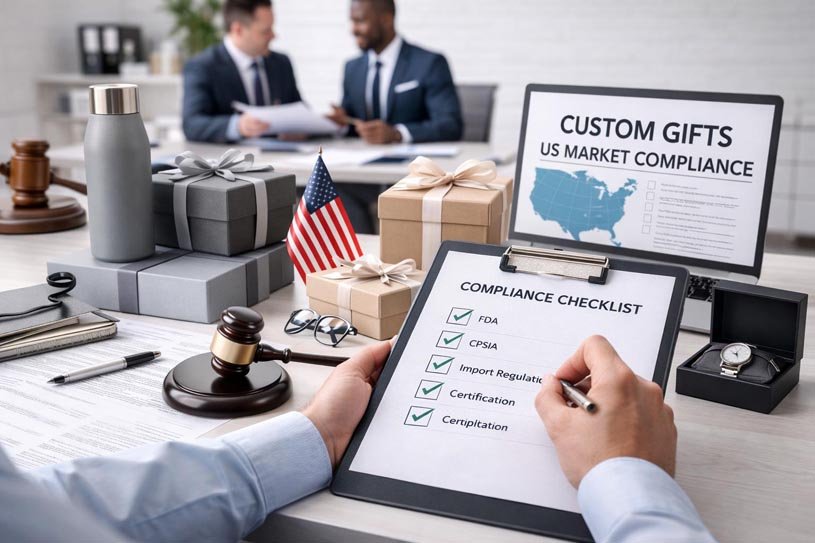
Compliance Checklist Table for Custom Gifts US Market Compliance
Below is a practical checklist you can directly insert into your blog or use with buyers.
Draft a compliance checklist table (FDA / CPSIA / labeling / testing)
| Compliance Area | Applies To | Key Requirements | Common Buyer Requests |
|---|---|---|---|
| FDA Compliance | Drinkware, food containers, wellness gifts | Food-contact safe materials, migration limits | FDA test reports, material declarations |
| CPSIA Compliance | Children’s gifts, general-use items | Lead & phthalate limits, tracking labels | CPSIA test reports, CPC |
| Labeling Rules | All imported promotional products | Country of origin, warning labels | Label photos, packaging samples |
| Product Testing | Regulated categories | Third-party lab testing | Full test reports, renewal dates |
| Import Documentation | All US-bound shipments | HS codes, invoices, COO | Pre-shipment document review |
How Smart Suppliers Turn Compliance Into an Advantage
The best suppliers don’t wait for buyers to ask. They lead with custom gifts US market compliance as part of their service.
When suppliers treat custom gifts US market compliance as a strategic capability rather than a checklist, it reshapes how buyers evaluate partnerships and award repeat business.
Proactive Compliance Saves Time and Money
When compliance is built into product development:
- Fewer redesigns
- Faster approvals
- Lower total cost
Buyers notice this immediately.
What US Buyers Look for in Long-Term Partners
US buyers value:
- Clear communication
- Honest documentation
- Consistent compliance support
They’re not looking for perfection. They’re looking for accountability.
Making Custom Gifts US Market Compliance Work for You
In today’s sourcing landscape, custom gifts US market compliance isn’t a hurdle—it’s a filter. It separates suppliers who understand the US market from those who don’t. When handled correctly, custom gifts US market compliance builds trust, speeds up decision-making, and positions you as a serious long-term partner rather than a risky vendor.
For corporate buyers, compliance equals confidence. And confidence is what closes deals.
FAQ 1: What does custom gifts US market compliance mean?
Custom gifts US market compliance refers to meeting US safety, labeling, testing, and import regulations for promotional and corporate gifts sold or distributed in the United States.
FAQ 2: Which US regulations apply to custom corporate gifts?
The most common regulations include FDA rules for food-contact items, CPSIA requirements for children’s or general-use products, and broader consumer product safety compliance USA standards.
FAQ 3: When are FDA compliant promotional products required?
FDA compliant promotional products are required when custom gifts come into contact with food or beverages, such as drinkware, kitchen gifts, or wellness-related items.
FAQ 4: What are CPSIA compliant custom gifts?
CPSIA compliant custom gifts meet US limits for lead and phthalates and include proper tracking labels. These rules apply mainly to children’s gifts and certain general-use products.
FAQ 5: What are the US import requirements for promotional products?
US import requirements for promotional products include correct HS codes, country-of-origin labeling, accurate customs declarations, and supporting compliance documentation.
FAQ 6: Why do US buyers ask for certifications for custom corporate gifts?
Certifications for custom corporate gifts help US buyers reduce risk, meet internal compliance standards, and ensure products align with safety, quality, and ethical sourcing policies.
FAQ 7: Are compliance requirements different for custom gifts for US buyers versus other markets?
Yes. Custom gifts for US buyers often face stricter safety testing, documentation requirements, and legal liability expectations compared to many other regions.
FAQ 8: How can suppliers simplify US compliance for custom gifts?
Suppliers can simplify US compliance for custom gifts by offering pre-tested materials, clear documentation, proactive compliance guidance, and early-stage design support.